Evga Geforce Rtx 2080 Ftw3 Ultra Hybrid Gaming Review
Our Verdict
The EVGA RTX 2080 Super Xc Hybrid performed well, averaging over 100 fps at 1440p ultra and 60 fps at 4K ultra. The hybrid cooling kept the menu much libation than other cards, but the pump has a soft hum. Priced at $789.99, information technology'southward one of the nearly expensive 2080 Super cards bachelor, but merely similar Hybrid setups tin can cool also.
For
- Lower temperatures yield higher boilerplate boost clocks
- Reduced heat dump inside your PC case
Confronting
- Higher toll than many air-cooled models
- Pump hum can exist heard over system fans
- Requires more space for the card and radiator
Tom's Hardware Verdict
The EVGA RTX 2080 Super 90 Hybrid performed well, averaging over 100 fps at 1440p ultra and 60 fps at 4K ultra. The hybrid cooling kept the carte du jour much cooler than other cards, but the pump has a soft hum. Priced at $789.99, it'south one of the most expensive 2080 Super cards bachelor, but simply similar Hybrid setups can cool also.
Pros
- +
Lower temperatures yield higher average heave clocks
- +
Reduced rut dump within your PC case
Cons
- -
College price than many air-cooled models
- -
Pump hum tin can exist heard over system fans
- -
Requires more space for the card and radiator
Over the by few months, we've looked at several Turing based Nvidia cards, which are some of the all-time graphics cards available and frequently rate near the height of our GPU hierarchy. None of them have been quite like the EVGA RTX 2080 Super Xc Hybrid, which consists of both an air cooler and an integrated liquid cooling solution to keep the GPU and retention frosty. In theory, that should keep temperatures down and allow boost clocks to run a fleck college than nigh air-cooled solutions while potentially cutting down on noise.
The EVGA RTX 2080 Super Hybrid XC we take for review comes with a small factory overclock (+fifteen MHz boost over reference speeds) on the core and the same 1,938 MHz (15.5 Gbps) clock speed on the RAM. We'll meet how this card and its hybrid cooling solution compares to the RTX 2080 Ti Founders Edition (FE),Asus ROG Strix RTX 2080 Super OC, RTX 2080 Super Fe, and an RTX 2070 Super Iron from the Nvidia side. Representing AMD in this review is an ASRock RX 5700 XT Taichi, Radeon VII, and reference RX 5700 and 5700 XT.
While performance was like betwixt the EVGA Hybrid Ninety and the other 2080 Super cards, the differences betwixt them are institute in the cooling solutions, features and price. At the time of this writing, both the EVGA RTX 2080 Super Hybrid 90 and the Asus ROG Strix are priced around $780 while the Nvidia RTX 2080 Super Founders Edition unremarkably goes for $700 (assuming you can find information technology in stock). ASRock's RX 5700 XT Taichi is priced at $439.99 by comparison, and the RTX 2070 Super nominally goes for $500 (again, when it'southward in stock).
For this review, we'll await at performance differences in frames per second (fps), how the hybrid cooler performed compared to traditional air-cooled cards, power consumption, and overall value.
Features
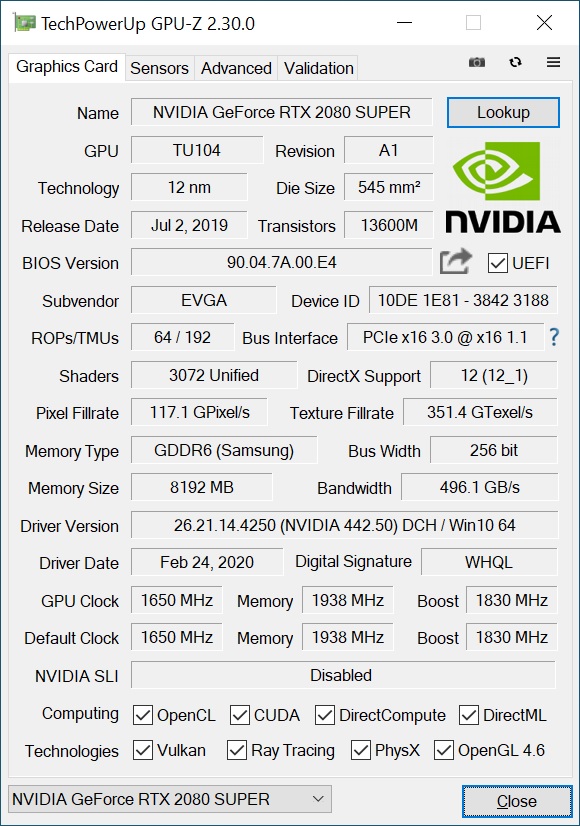
Though there are some differences between the 2080 Super and other RTX models (such as the SM count and later shaders, TMUs, and ROPs), all RTX 2080, 2080 Super, and 2070 Super cards sport the same Turing TU104 silicon nether the hood. The TU104 die is manufactured on TSMC's 12nm FFN (FinFET Nvidia) procedure using 13.half-dozen billion transistors on a 545mm square die. All iii TU104 cards come with 8GB of GDDR6 sitting on a 256-bit coach.
Clock speeds on the EVGA RTX 2080 Super Hybrid Xc are set at 1,650 MHz base clock with a listed boost clock of i,830 MHz. Unlike AMD cards, the Nvidia GPUs' listed boost clocks are more of a minimum whereas AMD boost clocks are a maximum (they run a lot closer to the Game Clock). Memory speed for the menu is ready to one,938 MHz (fifteen.5 Gbps effective) which yields 496.i GB/s bandwidth. This configuration is enough for gaming at its target resolutions of 2560x1440 or 3840x2160 (4K UHD).
Nvidia lists the Geforce RTX 2080 Super equally a 250W menu in Founders Edition form and recommends a 650W power supply. EVGA doesn't change the power draw or ability supply recommendation for the Hybrid 90. 6-pin and 8-pivot PCIe power connectors are required.
The following table summarizes the specifications of the Nvidia GeForce RTX 2080 Ti, RTX 2080 Super and RTX 2080 Founders Editions, along with the EVGA and Asus RTX 2080 Super cards.
| | GeForce RTX 2080 Ti Fe | GeForce RTX 2080 Super FE | EVGA RTX 2080 Super Hybrid XC | Asus ROG Strix RTX 2080 Super OC | GeForce RTX 2080 FE |
|---|---|---|---|---|---|
| Architecture (GPU) | TU102-300-K1-A1 | Turing TU104 (450-A1) | Turing TU104 (450-A1) | Turing TU104 (450-A1) | Turing TU104 (400A-A1) |
| SMs | 68 | 48 | 48 | 48 | 46 |
| CUDA Cores | 4352 | 3072 | 3072 | 3072 | 2944 |
| FP32 GFLOPS (Nvidia Boost / AMD Game) | 14231 | 11151 | 11244 | 11428 | 10068 |
| Texture Units | 272 | 192 | 192 | 192 | 184 |
| ROPs | 88 | 64 | 64 | 64 | 64 |
| Tensor Cores / RT Cores | 544 / 68 | 384 / 48 | 384 / 48 | 384 / 48 | 368 / 46 |
| Nvidia Heave/AMD Game Rate (MHz) | 1635 | 1815 | 1830 | 1860 | 1710 |
| Memory Clock (Gbps) | xiv | xv.5 | 15.5 | 15.v | xiv |
| Retentiveness Capacity | 11GB GDDR6 | 8GB GDDR6 | 8GB GDDR6 | 8GB GDDR6 | 8GB GDDR6 |
| Memory Bus Width (bits) | 352 | 256 | 256 | 256 | 256 |
| Retention Bandwidth (GBps) | 616 | 496 | 496 | 496 | 448 |
| TDP /TBP (Watts) | 260 | 250 | 250 | 250 | 215 |
| Transistor Count (billions) | 13.6 | thirteen.half-dozen | 13.6 | xiii.6 | 13.6 |
| Die Size (mm square) | 754 | 545 | 545 | 545 | 545 |
Design
The EVGA RTX 2080 Super Hybrid Xc is a dual-slot video menu measuring 10.4 x 4.4 x ane.6 inches (265.6 x 111.2 x 40 mm). The card is full-size and sticks out about an inch past the width of our ATX motherboard, making this a long bill of fare though certainly not the biggest we've tested. Height shouldn't be a concern equally information technology sits flush with the I/O plate, simply due to the length, it may non fit into small course factor (SFF) systems. Be sure to verify the infinite inside your chassis before buying.
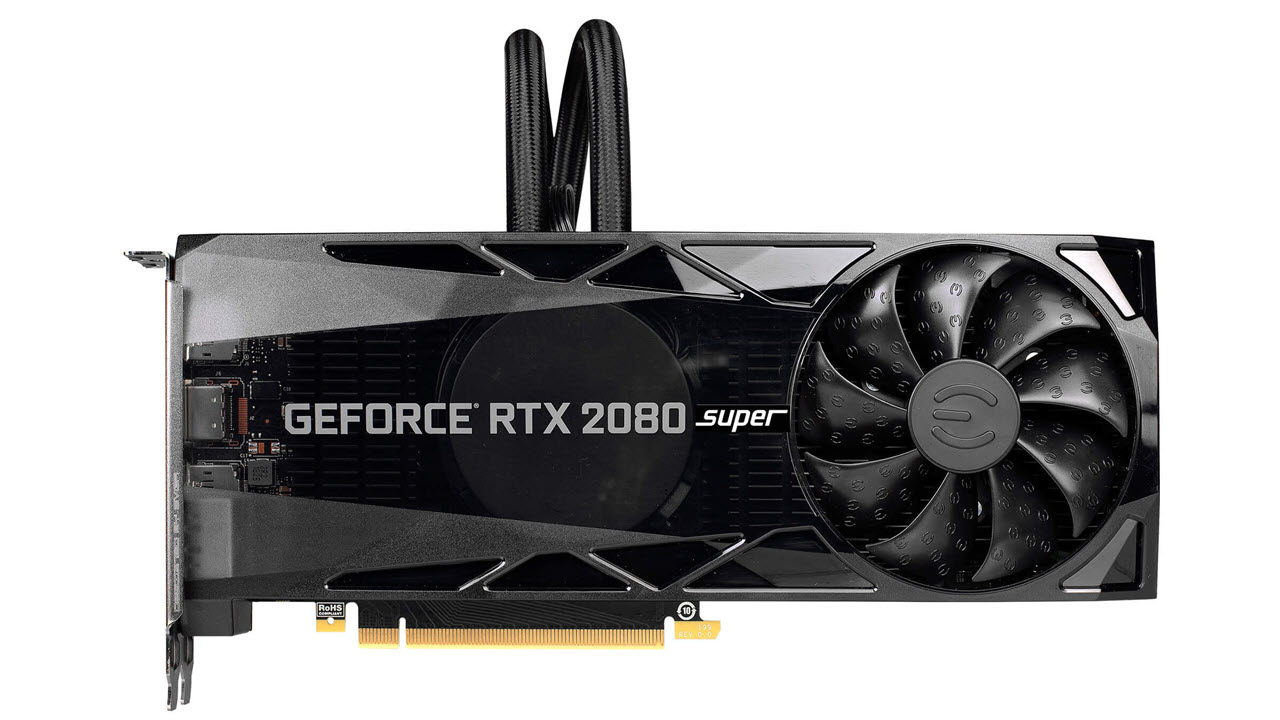
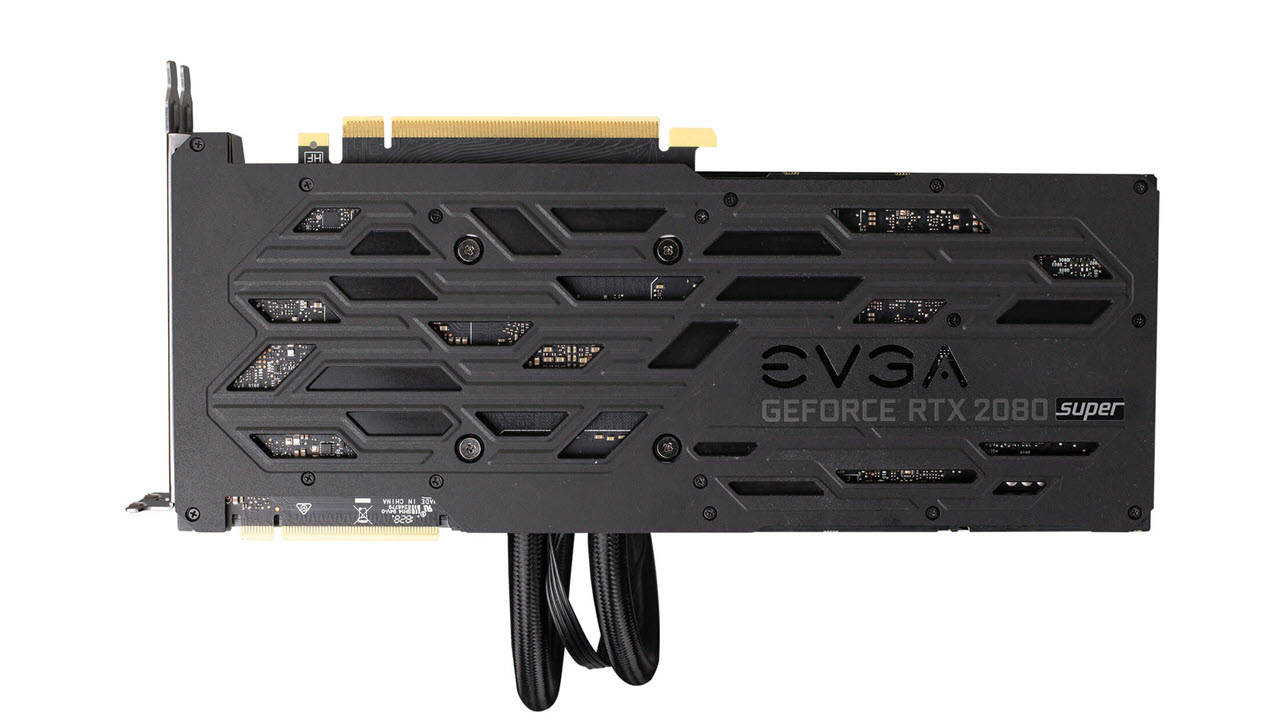
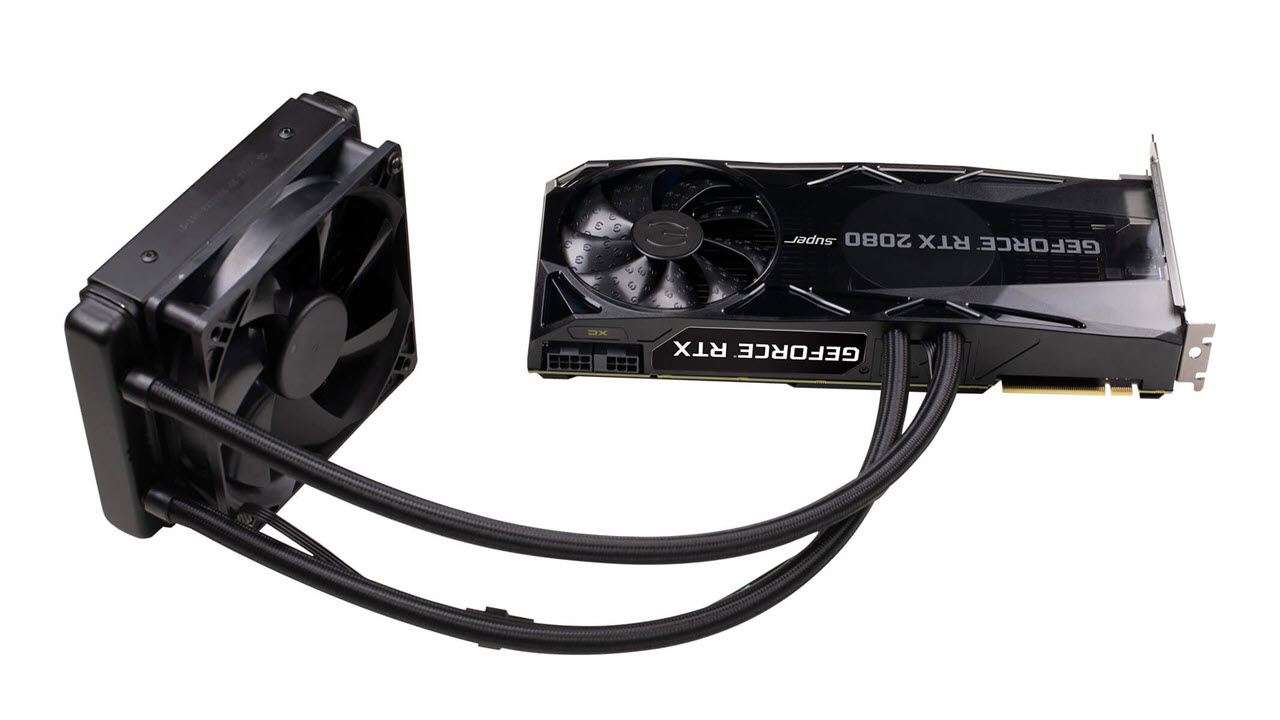
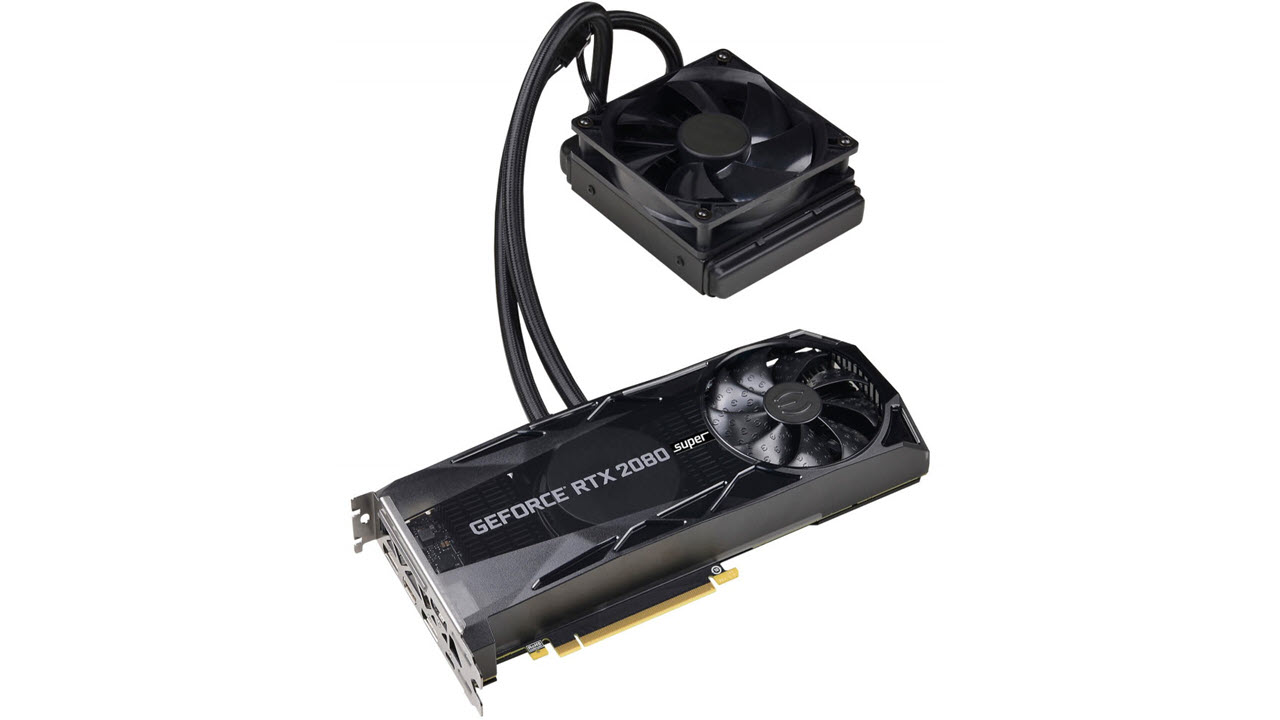
Like air-cooled cards, our Hybrid cooled EVGA uses a stylish plastic shroud with the GeForce RTX 2080 Super name stenciled beyond its smoked tinted cover. On superlative is "EVGA Hybrid" naming lit up through the only RGBs we find. On the right is a single ~85mm fan attached straight to a large heatsink, which blows cool air across the VRMs and out the rear and I/O side. The dorsum of the card sports a matte black powder-coated metal backplate that protects the rear of the PCB and helps passively cool the VRMs.
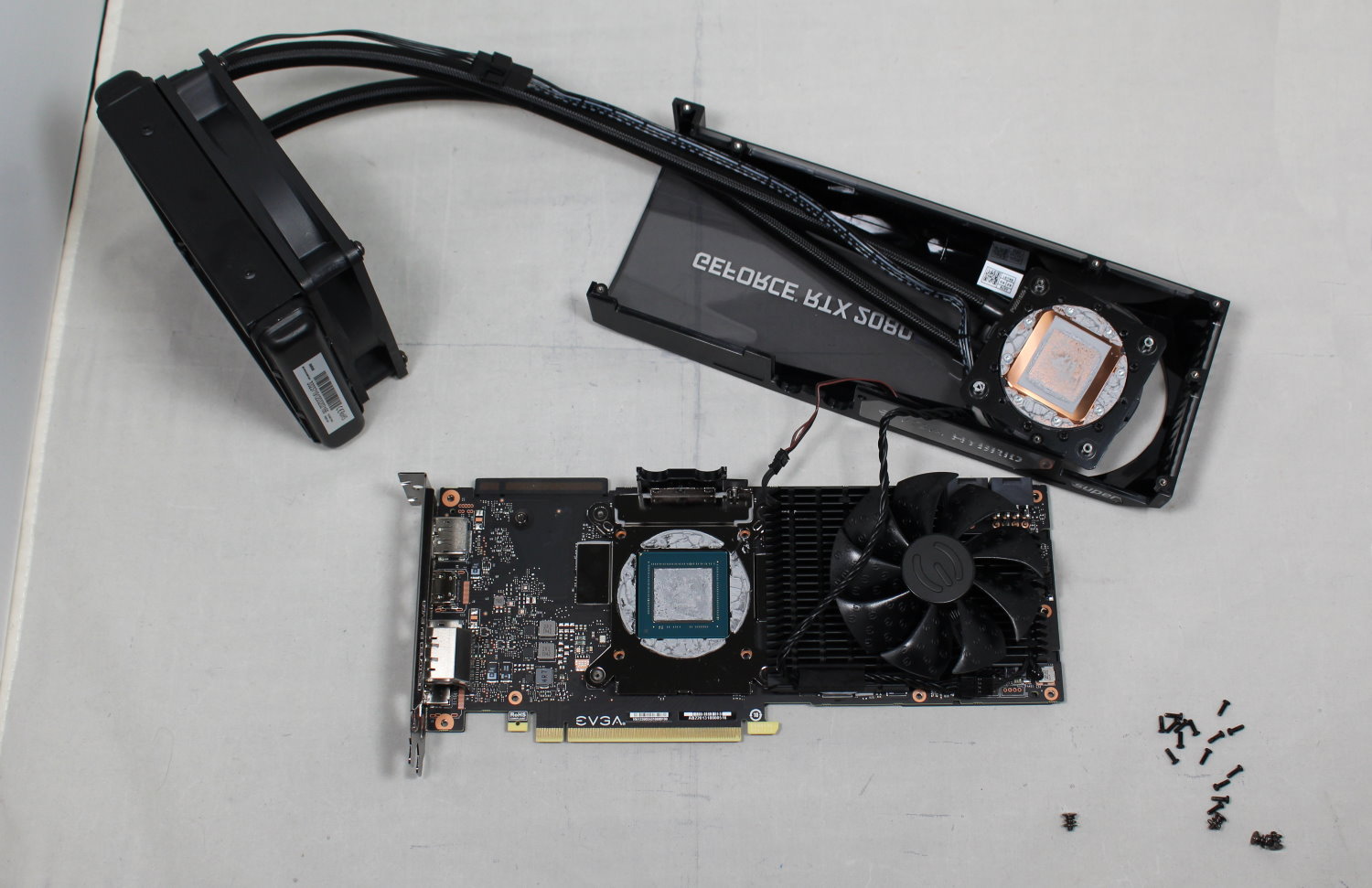
In social club to absurd the GPU and memory, a 120mm radiator attaches directly to the GPU core while a dedicated memory plate makes direct contact with the h2o cooling block for optimal memory temperatures. Attached to the loftier fins per inch (FPI) radiator is a swappable 120mm fan that does a expert chore moving air quietly. Both fans accept their own custom curves and tin be controlled manually through EVGA Precision X1 software. The VRM fan remains off during idle and low load operation, helping to minimize noise.
The EVGA RTX 2080 Super Hybrid XC uses a reference PCB sporting an 8+ii phase (GPU and Memory) VRM setup. The GPU VRM is controlled by an 8-channel uP9512P function, while the memory VRM is controlled by a uP9529P controller. The GDDR6 fries hidden below the retentiveness plate are made by Samsung (P/Due north K4Z80325BC-HC16) and specified to run at 2000 MHz (xvi Gbps effective). Even though this is a reference board, Nvidia did a good task ensuring the ability delivery arrangement could handle stock and overclocked operation.
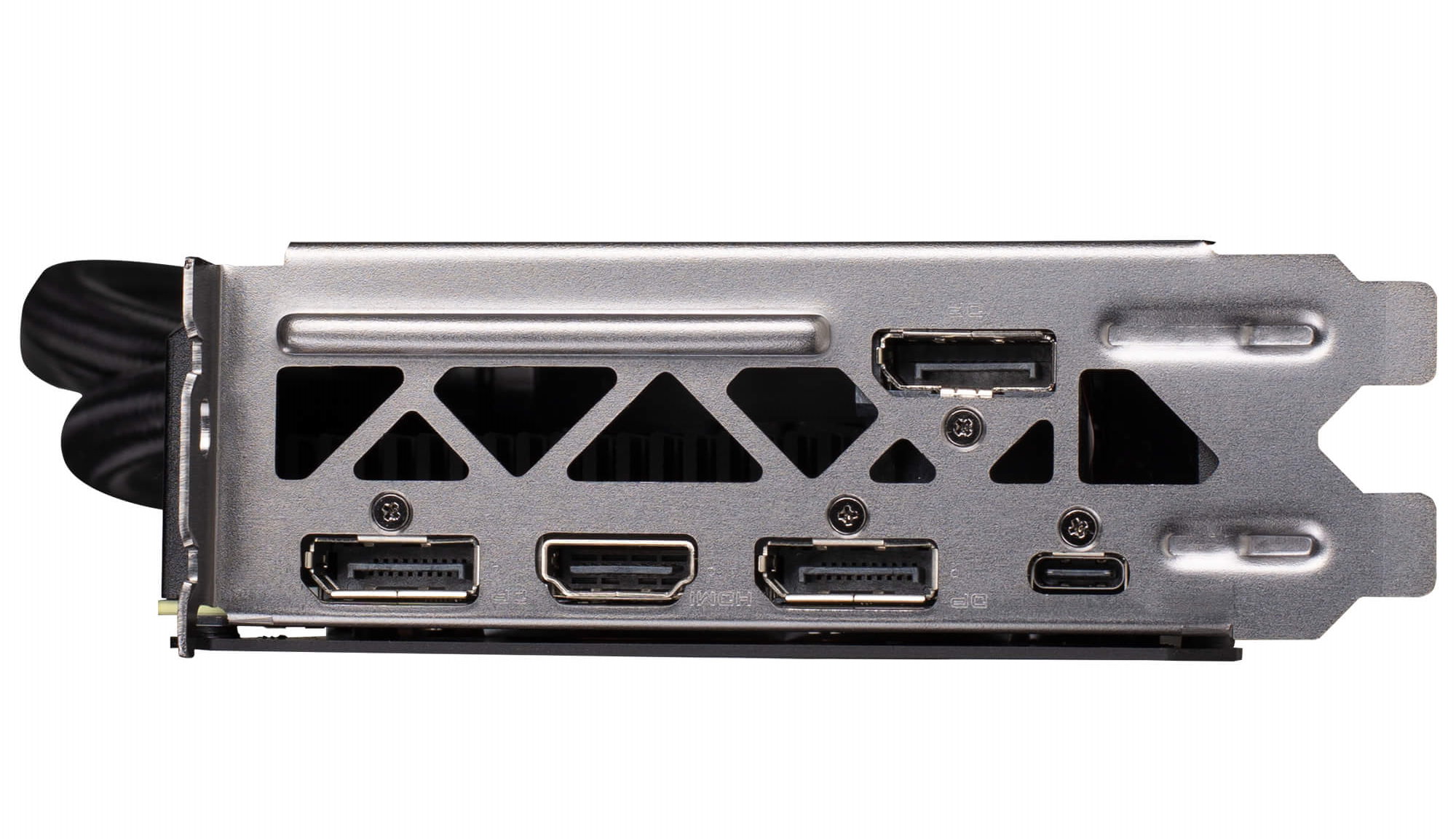
I/O ports on the EVGA card are standard fare for high-end Turing and include three DisplayPorts (1.4b), a single HDMI (2.0b) port and a VirtualLink USB Type-C port designed for VR headsets.
How We Tested the EVGA RTX 2080 Super Ninety Hybrid
Tom'south Hardware GPU Exam PC
Our current graphics card test system consists of Intel's Core i9-9900K, an viii-core/16-thread CPU that routinely ranks every bit the fastest overall gaming CPU. The MSI MEG Z390 Ace motherboard is paired with 2x16GB Corsair Vengeance Pro RGB DDR4-3200 CL16 memory (CMK32GX4M2B3200C16). Keeping the CPU absurd is a Corsair H150i Pro RGB AIO, along with a 120mm Sharkoon fan for general airflow across the test system. Storing our Os and gaming suite is a unmarried 2TB Kingston KC2000 NVMe PCIe iii.0 x4 bulldoze.
The motherboard is running BIOS version 7B12v17. Optimized defaults were used to prepare the system. We then enabled the retentivity's XMP profile to get the memory running at the rated 3200 MHz CL16 specification. No other BIOS changes or operation enhancements were enabled. The latest version of Windows 10 (1909) is used and is fully updated every bit of March 2020.
Our GPU hierarchy provides a complete overview of the GPUs at the center of various graphics cards and how the various models stack upwards confronting each other. For these individual tertiary-party menu reviews, we primarily focus on GPUs that compete with and are close in performance to the card that is being reviewed. However, we've overhauled our charting arrangement and are including multiple other GPUs now. The main points of interest will exist the RTX 2080 Ti Fe, RTX 2080 Super FE, RTX 2070 Super Atomic number 26 along with an Asus ROG Strix RTX 2080 Super OC. For AMD, we have the Radeon VII, RX 5700 XT and RX 5700 reference cards, along with an ASRock RX 5700 XT Taichi.
Our list of test games is currently Borderlands three, The Division 2, Far Weep 5, Final Fantasy XIV: Shadowbringers, Forza Horizon 4, Metro Exodus, Carmine Dead Redemption ii, Shadow of the Tomb Raider and Strange Brigade. These titles correspond a broad spectrum of genres and APIs, which gives us a good idea of the relative performance differences between the cards. Nosotros're using driver build 442.78 for the Nvidia cards and Adrenalin 20.iv.1 drivers for AMD.
We capture our frames per 2d (fps) and frame time data by running OCAT during our benchmarks. For The Division two and Metro Exodus nosotros use the .csv files the built-in benchmark creates. For clock and fan speed, temperature and power, we apply GPU-Z's logging capabilities. We'll be resuming our apply of the Powenetics-based system for graphics menu reviews in the near future.
Source: https://www.tomshardware.com/reviews/evga-rtx-2080-super-xc-hybrid
0 Response to "Evga Geforce Rtx 2080 Ftw3 Ultra Hybrid Gaming Review"
Post a Comment